Louise Fouqueau (she/her)
louise.fouqueau@ist.ac.at
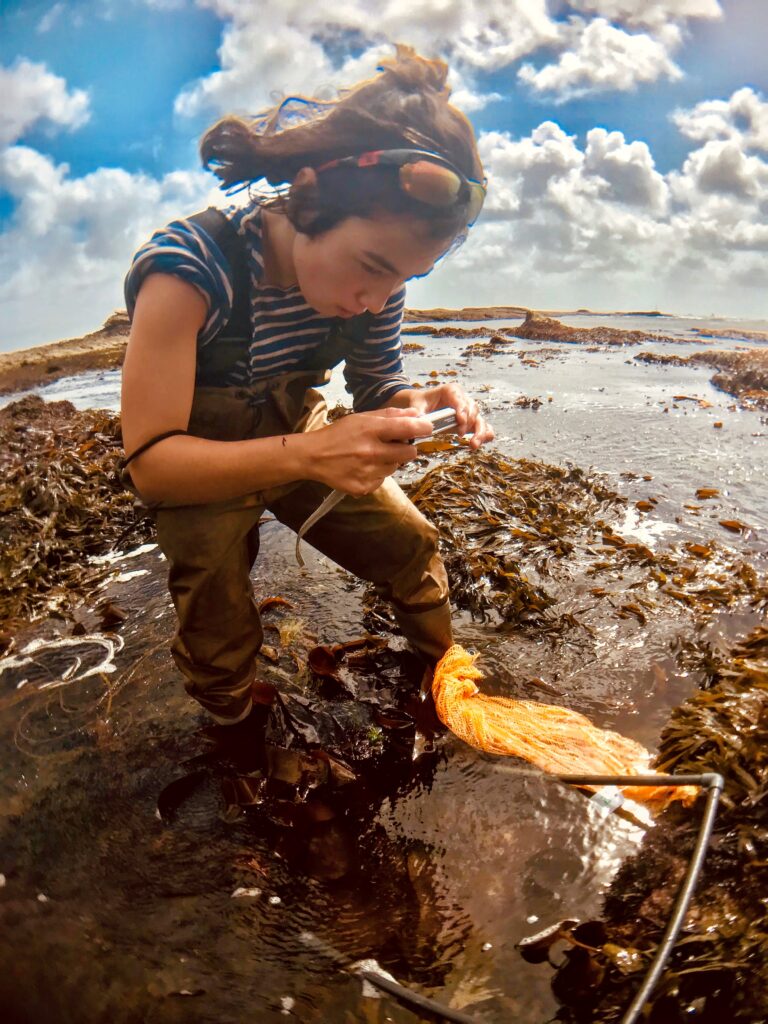
I am an evolutionary biologist and I try to bring together various empirical and theoretical approaches in order to study general questions concerning the specificities of populations located at the margins of species’ range distribution (demography, connectivity, and reproductive systems), and the consequence of these specificities on adaptive potential and the accumulation of deleterious mutations.
My project at ISTA aims to understand the evolution of self-fertilization at the range margins and its consequences for adaptation to changing environments or for the accumulation of deleterious mutations which are mainly studied using computer simulations. I am also working on various topics concerning Arabidopsis lyrata subsp. lyrata with Yvonne Willi’s group at the University of Basel.
Hilde Schneemann
hilde.schneemann@ist.ac.at
I am an evolutionary biologist interested in genetic interactions, hybridization, and speciation. During my PhD, I used fitness landscape models to capture and connect widespread patterns of hybrid fitness from the breeding and speciation literature. As a postdoc, I aim to analyze genomic signatures of background-dependent selection in controlled greenhouse crosses (Hibiscus trionum × H. richardsonii), and in a wild hybrid zone (Antirrhinum majus pseudomajus × A. m. striatum).
Google Scholar Profile
Rosina Soler (she/her)
rosina.soler@ist.ac.at
I am a vegetation ecologist focused on how life-history strategies are shaped by environmental change and biotic interactions, and how these mechanisms scale from population dynamics to plant diversification. My research combines field studies, manipulative experiments, and quantitative and synthesis approaches to understand population persistence, vegetation dynamics, and contemporary evolution.
In Barton group, I also coordinate the annual fieldwork in the hybrid zone (Pyrenees, Spain) that studies a wild population of snapdragons (Antirrhinum) that differ in flower colour. We record the occurrence of new and old flowering individuals (≈ 5,000 plants per year), take morphological measurements, and collect tissue samples for genotyping.